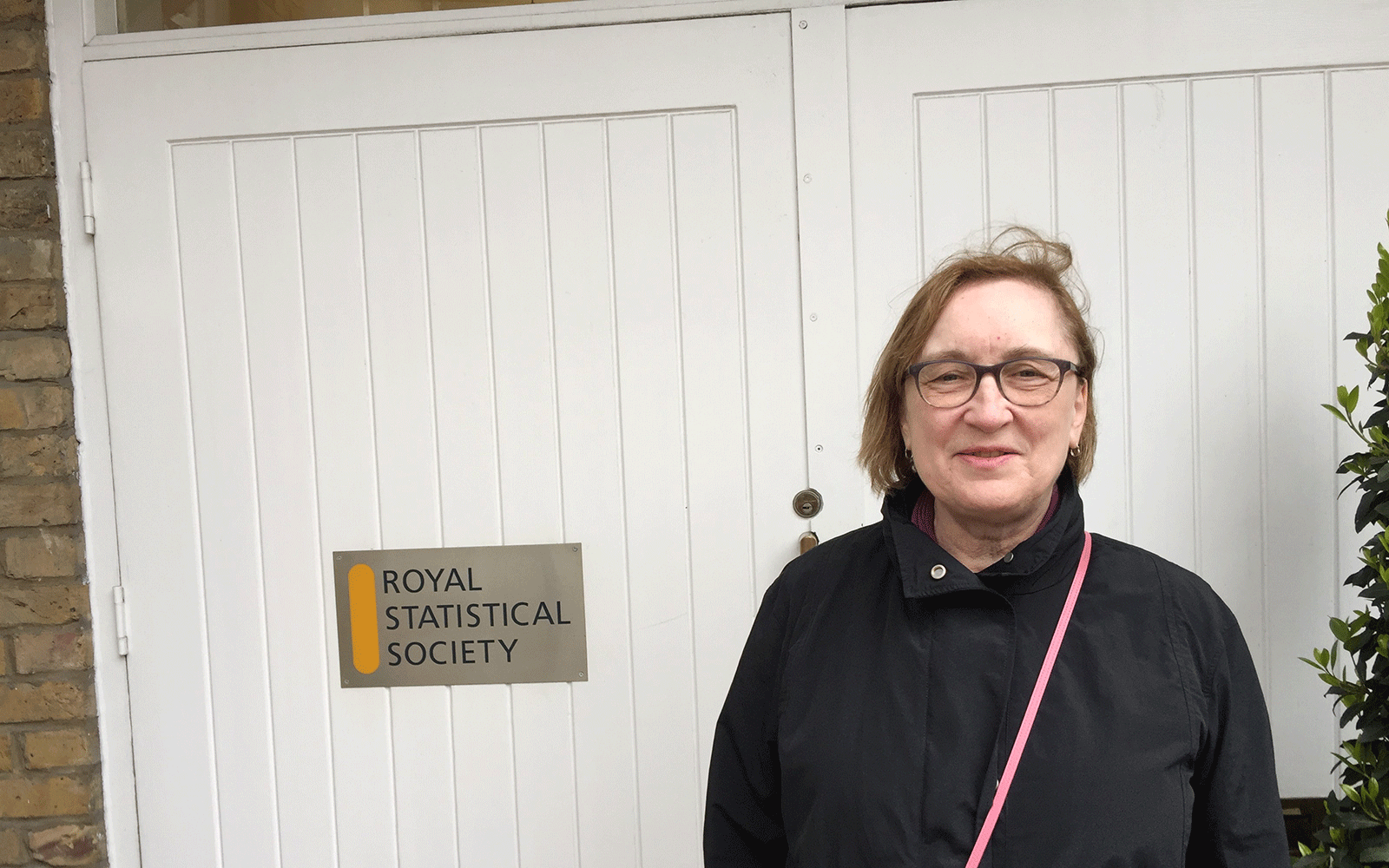
Despite big reputations in the statistical community, many women statisticians are not as well known as their male counterparts. Amanda L. Golbeck decided the written word could, and should, remedy that. Here’s how she researched and published books about two of her role models
John Lennon said that he always strove to write, record, and release a song within 24 hours. It took me 10 years to research, write, and publish a biography about Florence Nightingale David. It takes many more years to know a person than to make a song.
Biographies of women statisticians
I was a graduate student at the prestigious, complex, and electrifying University of California – Berkeley. It was at the turn of the 1980s. Then, almost all of the faculty members in the statistics department were men. But at the same time, there were two women statisticians there who had big reputations. They were Elizabeth Leonard Scott and Florence Nightingale David. I knew them both.
Mid-career, after doing academic administrative work for about 20 years, I returned to a decade of full-time faculty work before turning again to administration. At the start of my faculty decade, I pondered what I would do with my scholarship time. My friend and colleague Craig Molgaard suggested that I write a book about Scott.
The idea intrigued me. Women in science research like Scott were scarce and women leaders in academic science like David were almost nonexistent. I was familiar with Constance Reid’s book about statistician Jerzy Neyman. I also knew that Reid had written a few other biographies of mathematicians, including her sister Julia Robinson.
I may have chosen a career as a statistician who works with numbers, but I love to write
I decided to adopt Reid as a role model. It fit with my early experiences as editor-in-chief of two school newspapers and as a writer for a community newspaper. I may have chosen a career as a statistician who works with numbers, but I love to write. I thought, maybe I could be a person like Reid, but who writes about women statisticians.
Girls, women, and men need to read history that includes accomplished women, because then they will understand the worth and potential of women.
My biography of Elizabeth Leonard Scott
The first biography that I wrote was about Elizabeth Scott. I remembered as a graduate student being told stories about her talks on the topic of how women weren’t allowed to use the world’s biggest telescopes. I remembered her close association with renowned statistician Jerzy Neyman. I remembered doing my master’s thesis with her in statistics, and how encouraging she was.
As a doctoral student, I learned how to use the archive materials at Bancroft Library for a project on the history of anthropology. Many years later, thinking about the biography, I looked to see whether there were materials about Scott at Bancroft. There were 148 cartons of documents from her. It turned out that Scott died while still working. Bancroft boxed up every piece of paper from her office and moved it to the archive. A biographer’s bonanza! But her collection was listed as “UNPROCESSED. UNAVAILABLE FOR USE.”
At each visit to Berkeley, I looked in boxes until my eyes were blurry
I remember being called “tenacious” at my PhD defense. I used some of that tendency to move the Scott project forward. I asked the head of the university library and the head archivist at Bancroft for access to the unprocessed, unavailable Scott collection. I told them that I was a Berkeley grad and former advisee of Scott’s. I wanted write a book about her, and I would look at every piece of paper in the 148 cartons. They said yes.
I was living in Montana and traveled to Berkeley, over a thousand miles away, a half dozen times to review every piece of paper. Berkeley has two faculty clubs, historically one for men and one for women, and this turned out to be a very interesting part of the Scott story. Each time I stayed for about a week in one of the faculty clubs, and that really gave me a feel for the history. At each visit to Berkeley, I looked in boxes at Bancroft until my eyes were blurry. I copied every document that I thought would be useful in the book.
I also accessed other archival materials, for example, university catalogs and faculty senate records. I interviewed some people who knew Scott well. I connected with the maternal side of her family, which I excitedly discovered has philanthropic means. I wrote a grant proposal to them to support my archival trips to Bancroft, and the Waterman family funded it without asking for anything in return.
I experienced sadness at her setbacks and happiness at her many accomplishments
It was great to do this biographical work at my alma mater. It reconnected me to the university. I was able to re-walk some old paths and discover many new ones. I uncovered so many rich stories about Scott, many more than I could have guessed was possible. It was emotional: I experienced sadness at her setbacks and happiness at her many accomplishments.
At home, I sorted all of the extracted documents by date. Scott’s relatives were military and lawyers. As a result, and fortunately, she dated every piece of paper. I sorted all of the documents by date and identified themes which became sections of the book. Then I spent the next few years writing. Given all of my other work responsibilities, it took me about 10 years to get from idea to book.
The biography of Scott is titled, Equivalence: Elizabeth L. Scott at Berkeley. It was published in 2017 by Chapman & Hall/CRC.
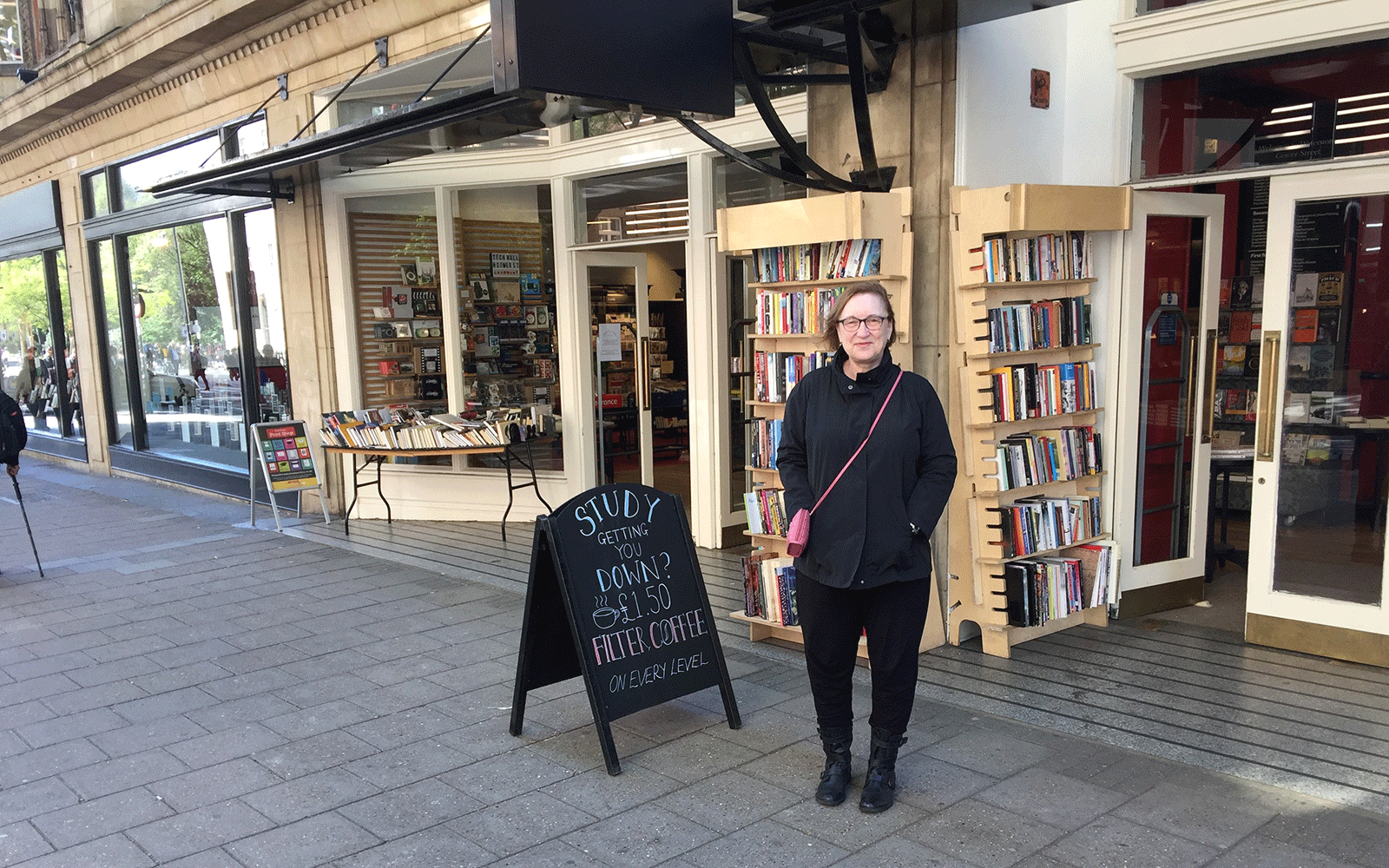
Picking up a copy of my just-published first biography, the one about Scott, at a London bookstore in April 2017. At the time I was working in the University College London archive on my second, about David. Photo: Craig Molgaard
My biography of Florence Nightingale David
After the Scott book was published, I thought I had another biography in me. I remembered the other woman statistician who had a big reputation when I was at Berkeley. I didn’t know her as well as I knew Scott, and Bancroft only had five cartons of documents in a collection for her. But I remember people saying her name – F.N. David – with great emphasis and reverence.
David was brilliant, different, and successful. She was a world class and influential statistician, a true legend in the field. She is identified as the greatest British woman statistician of the mid 20th century, as well as one of the greatest statisticians of her time. Like Scott, David was one of my champions.
I remembered that David told stories in such a compelling way that everyone thought she was a relative of the Florence Nightingale. I remembered that David dressed in a masculine way and like Scott was joined at the hip to Neyman. I remembered that she spoke in a British accent and was not afraid to speak her mind.

Florence Nightingale David working in her US Forest Service office, around 1977. Photo republished with the permission of the Institute of Mathematical Sciences
One day my dissertation advisor invited me to interview for a consulting position at the United States Forest Service. I accepted, and to my great surprise it was David who interviewed me. I learned that she had worked for the Forest Service for many years. I remember going home from the interview and saying, “Holy ****, I was just interviewed by F.N. David!”
David apparently instigated that particular consulting project. She wanted people to only use statistical measures that are appropriate for the scale of measurement. She especially wanted people to refrain from using methods developed for interval data on ordinal data. She must have liked my work, because I was hired on two consecutive consulting contracts. I produced a technical report that is still available worldwide.
Several times in my life, I have accepted huge responsibilities with no idea of how I was going to carry out and complete them. The David book was one of them. She didn’t have 148 cartons in her Bancroft collection, she only had five. This was not enough for a book, even a short one. I had to find more materials elsewhere. I had to look in less obvious places. It was a challenge.
I didn’t know where I would find enough material to answer my biographical questions. But one thing led to another discovery, and I did find the needed material.
I visited the village David grew up in, the colleges she attended, the university that she worked in for many years, and the cemetery she is buried in
I ended up being able to order copies of all of David’s many war reports, because they had just reached the age to become declassified. I found a person at the high school David went to – where David was a local hero – who cared about my project and sent me new archival materials. I accessed primary ancestry sources (birth, immigration, and death certificates, and census documents). I interviewed people who knew David, including some of her colleagues and students. I was able to order copies of all nine of David’s books and find reviews of them in the published literature.
I traveled several times to the United Kingdom. I found archival materials at Royal Holloway University about her undergraduate days. In the statistics library at University College London, I found copies of the dissertations that she supervised. I also found archival material at University College London, where David spent many years of her career. But I did not find those in collections under her name. I found them mainly in collections of men who she worked for or with, especially Karl Pearson, Egon Pearson, and J.B.S. Haldane. I eventually learned that this was a common problem in history, where women weren’t given their own collections.
I visited the village David grew up in, the colleges she attended, the university that she worked in for many years, and the cemetery she is buried in. I found answers to many questions I had about her, questions about the beginnings and endings of her career for which no one yet knew the answer: Why did David decide to become a statistician and a professor? Why did she decide to emigrate from the United Kingdom to the United States to lead and grow a new academic department in a research university, and be one of the first women in the sciences to do so?
Again, back at home, I sorted all of the found documents and findings by date. I identified themes. Given all of my other work responsibilities, it again took me about 10 years to get from idea to book.
The biography of David is titled, Florence Nightingale David: A Passionate Probabilist, Statistician, Historian, and Leader. It was just published in 2025 by Springer.
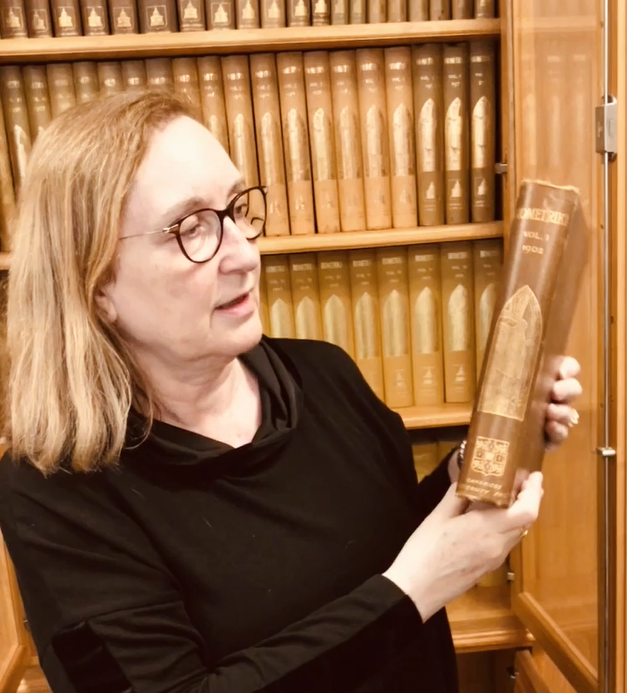
Me with Biometrica Vol. 1 No. 1, and the collection of Biometrica journals at the statistics library at University College London, January 25, 2019. Photo: Craig Molgaard
Role models need biographies
As I dug into their stories, I discovered that Scott and David were courageous and inspiring role models. I realized that role models do not have to be living human beings. Role models can come to life on the written page. From there, many can learn about how they overcame challenges, pursued passions, and made positive impacts. In comparison with a human being role model, a biography has the potential for greater reach, both geographically and in terms of numbers affected.
By the time that I began to work on the David book, I realized that my book about Scott was the only published book-length biography of a woman statistician other than the Florence Nightingale. Yet there were more than a few books about men statisticians, including ones about Karl Pearson, William Sealy Gosset, J.B.S. Haldane, R.A Fisher, George Box, and Jerzy Neyman. Now we have two books about 20th century women statisticians, namely Scott and David.
I realized that my book about Scott was the only published book-length biography of a woman statistician other than the Florence Nightingale
The Committee of Presidents of Statistical Societies (COPSS) has awards in the name of Scott and David. In 2018, I wrote a successful proposal to upgrade these awards to include named lectureships. So, in addition to knowing both Scott and David, I chose to write books about them because it is important to really know the people being celebrated, especially now that their awards have been upgraded to include the lectureships.
COPSS celebrates Scott for her lifelong efforts to further the careers of women in academe. Of special interest to me was that Scott didn’t just advocate for women, she used her research expertise to make the case to the profession, and she used her instructional expertise to make the case to her administration.
Together with the Caucus for Women in Statistics, COPSS celebrates David for being a role model for excellence in research, team science, statistics education, and service to professional societies. Of special interest to me was that David did everything one would expect of a top-notch statistician, but she hit a glass ceiling anyway.
David did everything one would expect of a top-notch statistician, but she hit a glass ceiling anyway
At the same time as the David award was being upgraded, I was made aware of the fact that many people didn’t know why she was important. This was a huge motivation for me to write the book about her. I knew enough about her that I believed she should not be forgotten. The book needed to be written to remind the profession and others of David’s importance in the history of statistics and science. She achieved things that no other woman had yet achieved. How did she manage to do it, and what can we learn from it?
Before I wrote the book about her, Craig Molgaard and I published an article about David. We pointed out how she was a prodigy, a warrior, a professor, a writer, a leader, and a celebrity. To me the most inspiring part of her story that was additionally revealed by the book research was how she didn’t let herself be stopped. She persevered until she got what she wanted and deserved.

F.N. David’s book Games, Gods and Gambling was published in 1962. U.S. customs would not allow David to bring this particular edition into the country, deeming it too risqué!
So far, everyone who has read the David book has indicated that they plan to next read her Games, Gods and Gambling book, sometimes referred to as “G3”. I don’t know why it didn’t occur to me when I was writing the David book that this would happen. It would be fun if the G3 book went into another printing!
Legacies
Scott and David shared this about their legacies: They did what they needed to do in order to succeed in their profession; but then they also took a road less traveled. This less traveled road was unique to each of them for their time, and it made them stand out from the crowd. For Scott it was to conduct and use solid research on women’s issues in academia. For David it was to conduct solid research on the history of probability, and then also to pivot and leap to another continent in order to lead.
I tell young people to find and take their own road less traveled. This is the way that they will stand apart from the crowd and make their big contribution.
Amanda L. Golbeck is a professor of biostatistics and associate dean for academic affairs in the Fay W. Boozman College of Public Health at the University of Arkansas for Medical Sciences, a professor emerita of statistics at San Diego State University, and a member of the Significance editorial board. She is the author of Equivalence: Elizabeth L. Scott at Berkeley and Florence Nightingale David: A Passionate Probabilist, Statistician, Historian, and Leader. Read the Significance review of the David book here.
You might also like: Democracy in the UK: has female representation improved?