
The 2026 FIFA World Cup is a gift: for football fans, naturally, but also the kind of stats nerds who salivate at the sight of a complicated sports ranking system. So, let’s kick off…
The power of 2
As we move through the World Cup festival of football, there’s a parallel World Cup of nerdiness going on at the same time, as people pore over the permutations and combinations which make up the “ranking of third place teams” outcomes.
The rules seem labyrinthine: the 8 best of the 12 teams placed third in their groups will be assigned to a place in the last 32 according to the outcome of a look-up table with 495 rows in (from page 80).
It’s natural to throw your hands up in horror, and decide the whole thing is needlessly complicated. However, it’s worth understanding where it has all come from and to see that this convoluted draw structure achieves at least two valuable aims.
It’s all a consequence of FIFA’s desire to grow the World Cup. If we have a “classic tournament” where the number of teams is a power of 2 – 16 teams as from 1954 to 1978, or 32 as from 1998 to 2022 – then everything is easy. You can split the teams into groups of 4, where just the two top teams qualify.
Even better, it’s possible to plan the draw in advance: we can put each group’s top team and second place in opposite halves of the knockout draw, so they are guaranteed not to meet again until the final. (This didn’t happen in 2002, when not mixing the groups up properly to maintain the two-host plans across Japan and South Korea meant that Turkey and Brazil met in the semifinal, having already played each other in the group stage).
Scotland could come third in their group following their final game with Brazil, and be rewarded with… their next game being a round-of-32 match against Brazil
When the World Cup was a 24-team tournament (and now the European championships are the same), such a simple structure wasn’t possible. In that case, with 6 groups of 4 you need a system where the best 4 third place teams are assigned to places in the knockout draw – but a quick calculation will show that there are only 6-choose-4 possibilities, or 15 different sets of teams to assign, and so the look-up was at least manageable.
Whereas now, with 48 teams, there are 12-choose-8, or 495 different possible sets of third place teams, and things start to get complicated. Of course, we could just do a simple random draw once the groups are finished. We could put the 8 teams into the 8 empty slots in the draw by drawing them out of a hat. However, that would have two potentially undesirable consequences which FIFA’s more complex draw avoids.
We want to mix up teams properly
There’s a general principle that we want to play as many different fixtures as possible during a tournament. We already saw that a badly-applied classic tournament led to the Brazil-Turkey game being repeated at the semi-final stage, which was bad enough. But worse things still could happen with a simple random draw.
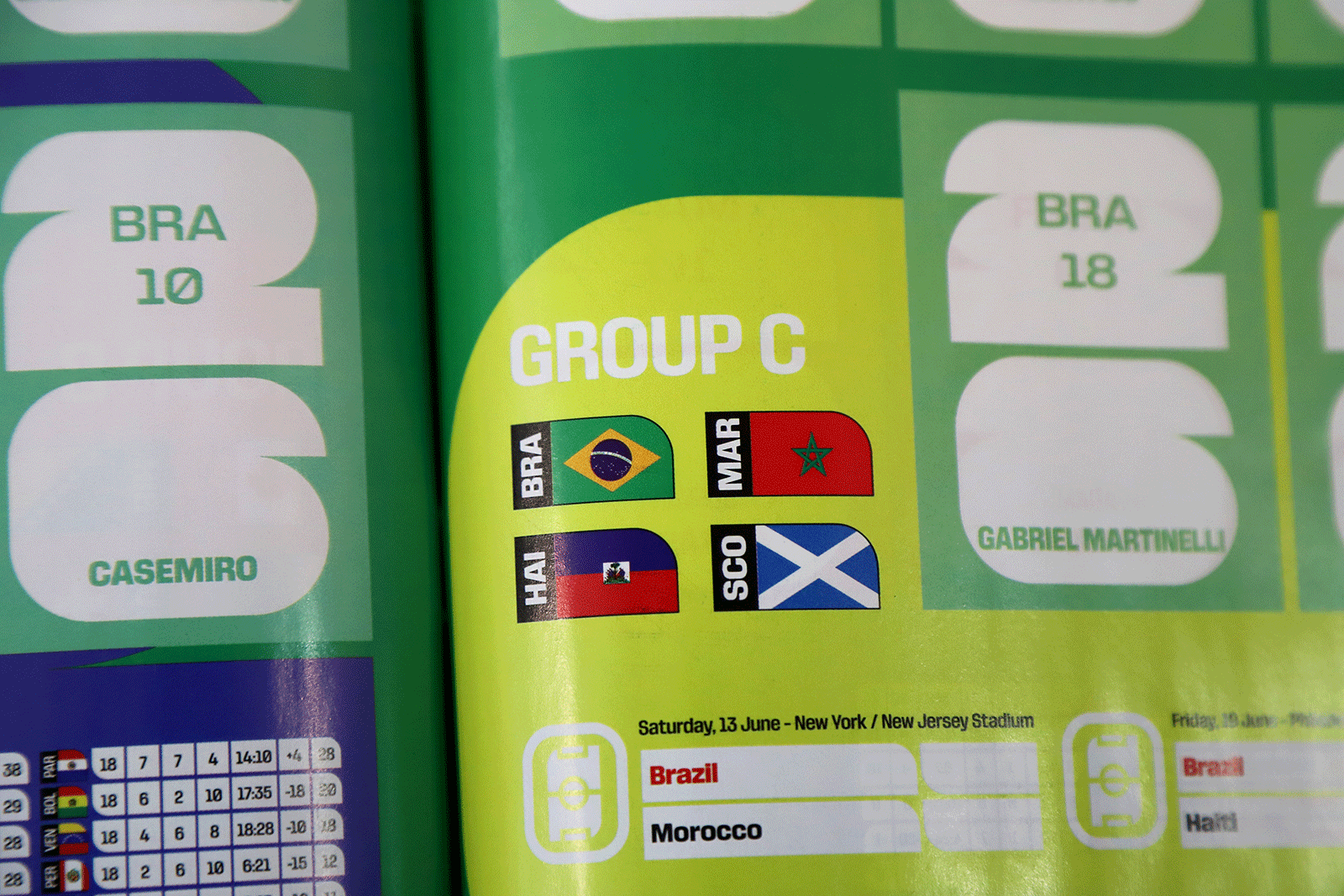
It’s possible under this system that, for example, Scotland could come third in their group following their final game with Brazil, and be rewarded with… their next game being a round-of-32 match against Brazil. This wouldn’t seem interesting or fair.
Playing Brazil once is bad enough for Scotland; but twice? Luckily, FIFA has a solution. Photo: cfg1978/Shutterstock
So we’d like to avoid repeated games, but the challenge is that we don’t know which eight teams are going to qualify, in order to know what scenarios to avoid. FIFA’s solution is to bracket the possible fixtures together in a way which ensures that no fixture can recur earlier than the quarter-final.
For example, looking at the bottom eighth of the draw, the Group B and K winners cannot play the second- or third-place teams from Group B or K in either of their first two knockout games, and the same kind of structure has been designed into each part of the draw, whoever might come through in third place.
The rest is history
So far, to statistically minded readers, it might feel like a classic sort of experimental design problem. These sort of combinatorial patterns to mix up experimental units in a fair way would be familiar to Fisher and his tea-tasting problem, or may remind some people of fancier block designs involving assigning different combinations of treatments to different parts of the same field.
But there’s an important way that football differs from cups of tea or field trials. The players and fans are only human, and the group games and the round of 32 run back to back with no rest day between them. Given that Groups J, K and L play their final game on 27 June, it wouldn’t exactly be fair to put their third place team into the first knockout game on the 28th. The players would be exhausted and need recovery from the game itself, even without considering the logistics of trying to move teams and fans to a destination somewhere across a large continent.
The particular choices of combinations have been constrained by the desire to give teams a rest
As a result, the particular choices of combinations have been constrained by the desire to give teams a rest. The first knock-out game involving a third-place team is on 29 June – but the only teams who can appear there are from groups A-D and F, all of whom played their final group game by the 25th. If Groups J, K and L provide qualifiers by this route, they can’t be called on to play before 1 July. It’s not ideal, but roughly speaking each team should get at least a four-day break.
Of course, once the round of 32 starts, the draw is fixed and football fans can focus on the games, and on dreaming their side’s route through it. But, for now, there’s also plenty of excitement for mathematicians and fans of statistical experimental designs as we wait to see how it all shakes out.
Oliver Johnson is professor of information theory and head of school in the School of Mathematics at the University of Bristol, UK, and author of the books Numbercrunch (Heligo Books) and Information Theory and the Central Limit Theorem (Imperial College Press).
You might also like:
Is there a World Cup hangover for the top teams?
Home advantage: what’s changed since Covid?
Soccer Analytics: Unravelling the Complexity of “The Beautiful Game”