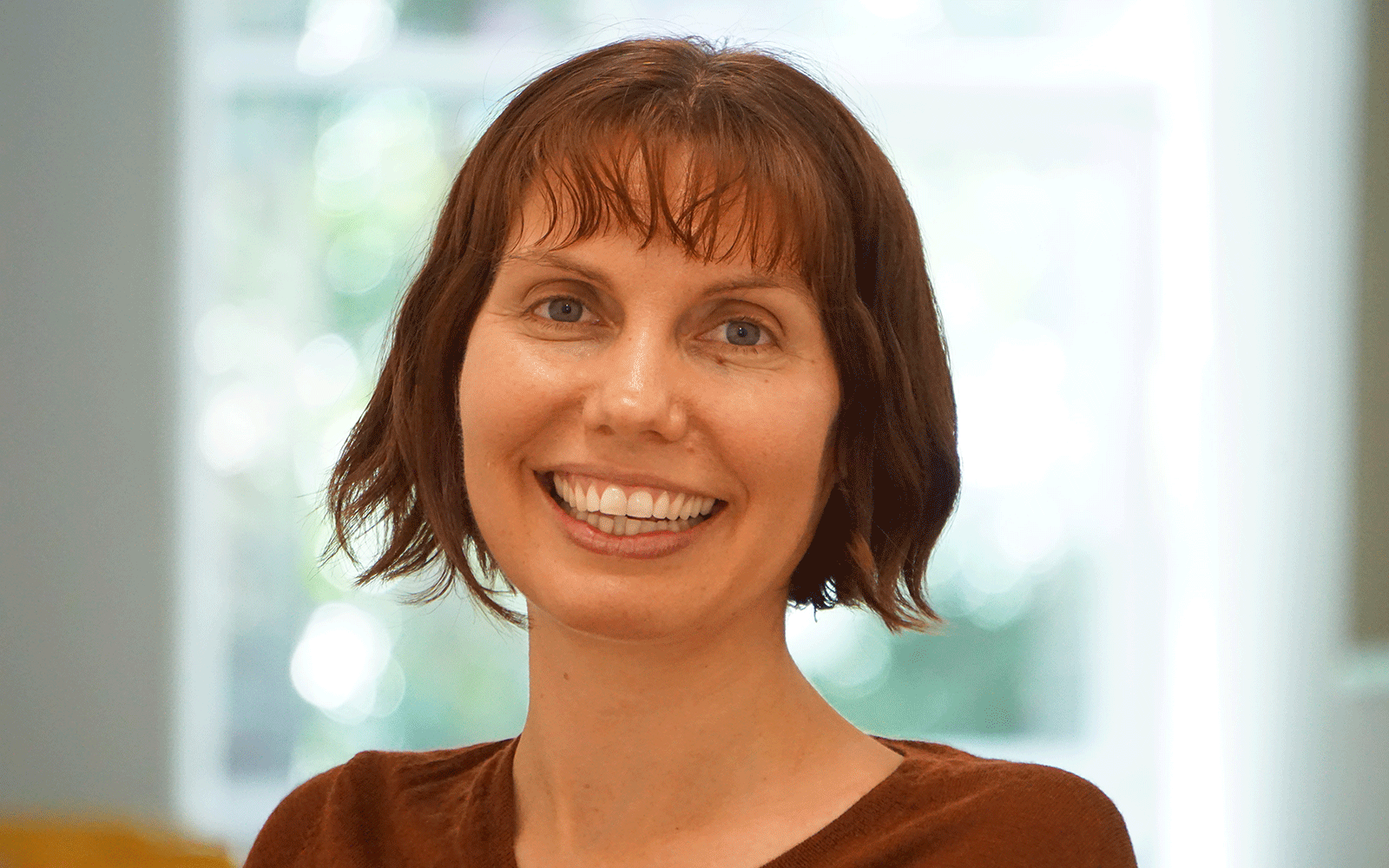
Susanna Cramb is a biostatistician and a strategic research fellow at the Institute of Health and Biomedical Innovation, Queensland University of Technology (QUT), Australia. She is also a member of the Significance editorial board.
Can you remember the moment you “fell in love with” statistics?
After detesting statistics in high school and during my medical science undergraduate degree, I fell in love with biostatistics during my master of public health and tropical medicine when I saw how powerful and useful it was. Statistics illuminates our world!
Please give us a brief overview of one of the most interesting projects you’re involved in right now.
Ooh, so many to choose from! The Queensland Injury Atlas is a project I am co-leading, where we have obtained a large linked dataset —starting with injury-related hospital admissions, linked to ambulance, flight retrievals (Queensland is large!), emergency department, compensation scheme and death datasets. We have created an interactive atlas which allows users to compare numbers of records or costs, provides a huge range of filtering options and also allows you to see de-identified individual patient journeys through the healthcare system. The next step is to determine what our stakeholders desire in terms of rates, use appropriate methods to generate robust, accurate rates, and develop additional innovative, interactive visualisations allowing comparisons. Given the detailed data, only authorised users are allowed access, but we plan to ultimately use it to improve trauma care and services.
What statistical techniques do you use most in your day-to-day work?
Regression models, ranging from simple linear regression through to complex Bayesian spatio-temporal models.
There are many brilliant statisticians, at all career stages, and I’ve been fortunate to be mentored/befriended by some of the world’s best!
What living statistician/data scientist most inspires you right now, and why?
There are many brilliant statisticians, at all career stages, and I’ve been fortunate to be mentored/befriended by some of the world’s best! I admire David Spiegelhalter for his communication, Adrian Barnett for his integrity, Karen Lamb for her passion, Ben Harrap for his commitment to equity, Kerrie Mengersen for her ability to bring collaborators together, Louise Ryan for her authenticity, Noel Cressie and Andrew Zammit-Mangion for their epic spatio-temporal work, and there are so many absolutely brilliant early career statisticians, including Rex Parsons, James Hogg and Conor Hassan. But there are many that inspire me, because so many are doing incredible, pioneering work while also investing in others.
If you had unlimited time, money and access to data, what is a question that you would you love to find an answer for?
How can we improve health outcomes for the marginalised? This includes people living in remote areas, Indigenous peoples, socioeconomically disadvantaged, culturally and linguistically diverse groups, and those with disability or who are stigmatised, because everyone should be able to flourish.
You might also like: 5 minutes with: Nicole White