The USA’s National Football League (NFL) draft is a hugely anticipated annual ceremony determining which players will play for which teams. Last year, over 16 million people watched the first round of the draft live on TV. The 2026 NFL draft, which this year takes place in Pittsburgh, Pennsylvania, is heavily dependent on the opinions of professional scouts. But, writes Niven Winchester, an algorithm has been shown to reveal undervalued and overvalued quarterbacks
Last year, we used an algorithm to assess how 2025 draftee quarterbacks were likely to perform in the NFL and compared our evaluations with traditional scout rankings. In this article, we assess quarterbacks in the 2026 draft and evaluate how the algorithm’s top pick for 2025 performed in their rookie NFL season.
Evaluating 2026 draft quarterbacks
The algorithm draws on data from college football to forecast how rookie quarterbacks will perform in the NFL. Performance is assessed using ESPN’s Total Quarterback Rating (QBR), which runs from 0 to 100, with higher scores reflecting stronger play.
For each draftee quarterback, the algorithm produces an estimate called Max5-QBR. This is the highest QBR a quarterback is expected to reach within their first five seasons in the NFL. The table below presents Max5-QBR estimates for the leading quarterback prospects in the 2026 NFL Draft, alongside their ESPN scouting grades.
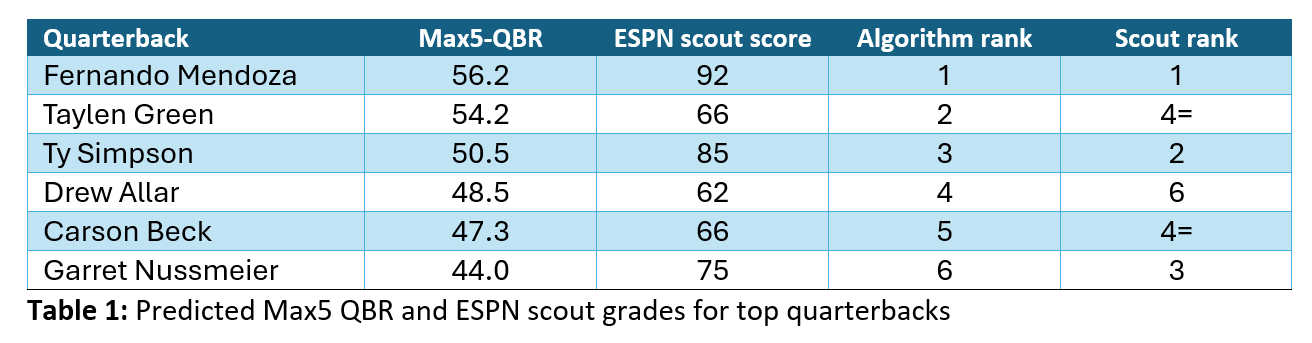
Fernando Mendoza is rated as the top quarterback prospect by both the model and the scouting grades, and it would come as little surprise if he were the first quarterback selected in the 2026 draft.
Evaluations for Taylen Green differ sustainably across the two predictors. According to the algorithm, he is the second-best quarterback in the draft and is only marginally behind Mendoza. On the other hand, scouts consider Green to be only the fourth best quarterback prospect.
The other notable ranking difference is that Garret Nussmeier is the sixth ranked prospect by the algorithm and is noticeably behind his peers but is the third best candidate according to scouts.
Scouts undervalue passing
Differences between algorithmic and scout rankings reflect the relative emphasis placed on rushing ability. When both scout scores and a measure of rushing ability are included in a model predicting the NFL performance of college quarterbacks, rushing ability has a positive and statistically significant effect on NFL outcomes. This implies that scouts tend to place too little weight on rushing ability when evaluating the NFL potential of college quarterbacks.
The algorithm’s emphasis on rushing explains why it views Taylen Green as undervalued by scouts and Garret Nussmeier as overrated. Among the top quarterback prospects, Green recorded the strongest college rushing statistic (5.6 yards per carry), while Nussmeier had the weakest (-1.1).
Potential sleepers
Two unorthodox prospects are Cole Payton and Diego Pavia. Payton played college football in the second-tier Football Championship Subdivision, while Pavia has not yet received an ESPN scout score, so neither has been evaluated by the algorithm. Both, however, are not only capable passers but also posted strong college rushing statistics, making them intriguing candidates.
How has the algorithm performed in the past?
For the 2025 draft, the algorithm rated Jackson Dart the top quarterback prospect, while scouts considered Dart only the third best quarterback. In the 2025-26 season, Dart’s QBR was 57.5, the highest among rookie quarterbacks. Like Green, Dart had the best college rushing statistics in his cohort.
Further, a systematic analysis (see Figure 3 of the article describing the algorithm) shows that the model’s predictions of NFL performance for college quarterbacks align more closely with actual outcomes than those from a model based only on scout evaluations.
That said, college performance does not always translate to the NFL and some of the algorithm’s highly rated draft picks don’t always work out in the NFL. As Yogi Bera once said, “It’s tough to make predictions, especially about the future.”
The highlight reel
The algorithm’s assessment of the NFL prospects of Fernando Mendoza as the top prospect agrees with scouts. However, the algorithm places a greater weight on rushing ability than scouts and suggests that Taylen Green is undervalued, while Garret Nussmeier may be overrated.
As the 2026 draft approaches, it will be interesting to see whether the quarterback draft order follows scout evaluations or aligns more closely with the algorithm’s rankings.
The 2026 NFL draft takes place 23–25 April 2026 in Pittsburgh, USA.
The algorithm was developed by Joe Craig at the University of Colorado-Colorado Springs and Niven Winchester at Motu Economic and Public Policy Research.
Niven Winchester is a professor of economics at the Auckland University of Technology, and a senior fellow at Motu Economic & Policy Research.
You might also like: Bend it like Beckham: The statistics of womens’ football
Home advantage: What’s changed since Covid?