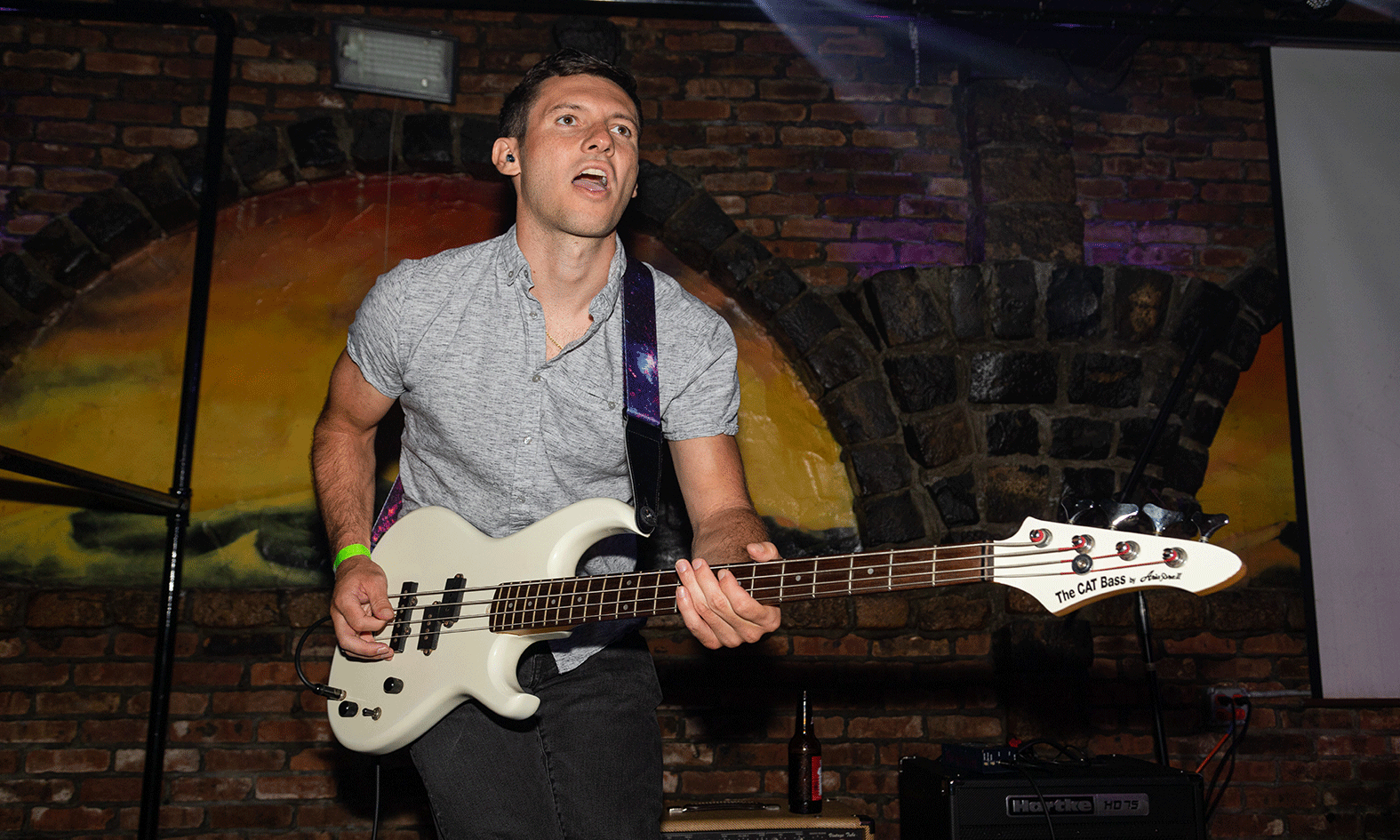
Chris Dalla Riva writes about pop music and data, and his debut book, Uncharted Territory: What Numbers Tell Us about the Biggest Hit Songs and Ourselves is reviewed in the November 2025 issue of Significance. We asked him more about his research and the best places for fellow music-and-stats fans to dig around
When did you realise data about music was so fascinating? In other words, what brought you here?
As I was going through school, I always felt there was this idea implicitly expressed that you either liked math and science or you liked English and history. I never understood that dichotomy. Doing math scratched the same part of my brain that writing an essay did. As I was studying mathematics and economics in college, along with playing in various bands, it only felt natural that I would look at music through an analytical lens.
How did you learn the technical skills involved in data gathering and analysis?
My undergraduate education, especially my econometrics classes, gave me a good foundation for how to conduct sound statistical analyses. After college, that theoretical knowledge got more practical use when I spent a few years working in antitrust consulting in Boston. I was not cut out to be a consultant for life, but economic consulting gives you great experience at applying abstract principles to a variety of arenas, whether that be pharmaceuticals, professional sports, or entertainment. When the consulting chapter of my life closed, I got a job for the music streaming service Audiomack. That allowed me to learn how to apply my data skills specifically to music. (It also helped that my coworker Bill taught me how to use SQL.)
I guess that’s most where my analytical skills came from. Data gathering is more of an art than a science, and it is an art best learned by doing. I write a weekly newsletter about music and data that’s called Can’t Get Much Higher and post about much of the same stuff on TikTok. The best way to learn how to find data is to be forced to find it because you have a question that you can’t stop thinking about.
I regret the years that I spent thinking every disco song was a plastic mess
What discoveries most surprised you while researching this book?
Musical evolution is often downstream of technological innovation. No, technology is not deterministic in the world of music, but it has a large, quiet impact. Take the way people sing as an example. In the early 1900s, you had singers with big booming voices, like Enrico Caruso, find popularity. Why did Caruso sing like that and not like the soft croon of Frank Sinatra or the wild yawp of Mick Jagger? Caruso came up singing on the stage, sometimes without amplification. If you wanted people to hear you, your voice had to boom. Early recordings functioned much the same. Quiet sounds could not be picked up well. As microphone technology improved, we began to see a wider range of vocal styles on our most popular songs. This is just one example, but it’s part of a larger trend that I would see repeatedly.
On a more concrete note, I also discovered how much I loved disco. I regret the years that I spent thinking every disco song was a plastic mess.
Did anything make you laugh? Feel sad?
One of the great powers of music is that it will take you on a rollercoaster ride of emotions. Listening to 1,200 songs across the course of 65 years is a good way to make sure you hit every possible point on that emotional rollercoaster. I’d often find myself laughing at ridiculous trends that cropped up over the decades, including silly novelty songs of the late-1950s (e.g., “The Chipmunk Song”, “Itsy Bitsy Teenie Weenie Yellow Polkadot Bikini”) and over-the-top fashion prevalent in late-1980s music videos (e.g., “You Give Love a Bad Name”, “Here I Go Again”).
There are certainly trends that I wish were going in a different direction. Like, I wish that bands rather than solo artists still regularly found their way to the top of the charts in the United States. But I don’t think that trend makes me sad. The things that made me sad were the artists that died too young (e.g., Jim Croce, Janis Joplin, Biggie Smalls) and the songs themselves. If you don’t feel something when listening to stuff like “Oh Girl” by The Chi-Lites, “Kiss and Say Goodbye” by The Manhattans, “Against All Odds (Take a Look at Me Now)” by Phil Collins, and “So Sick” by Ne-Yo, then you and I are cut from a different cloth.
Chris studied mathematics and economics in college, while also playing in bands
How did you research your books, and what data sets do you recommend to people interested in digging into this stuff themselves?
My main data source was one that I built while listening and later made public on my website, www.chrisdallariva.com/uncharted. That powered much of my book. That said, there are tons of great music resources online that are either free or affordable. Billboard chart history is easily downloadable. Chartmetric has more music data than anyone could dream of. Lyrics are readily available across the web. WhoSampled is a great resource for sample, interpolation, and cover data. BMI and ASCAP have a rich tool for songwriting credits. Discogs makes album and single art available. Though it’s been pared down a little, the Spotify API has some nice metadata. Also, Wikipedia is surprisingly a great place to look for data if you get creative.
You have some thoughts about the role of AI in music. Could you summarise them?
The last century is filled with examples of musicians being fearful of new technology and everything turning out okay. Because of that, part of me wants to believe that the use of AI in music will be pretty much the same. I sadly don’t think that’s the case, though. There are real risks with parts of this technology. First, it’s worth noting that there are many AI-powered tools floating around the music industry. I think some, like stem separation, are worth celebrating.
Generative audio is where things get dicier. Beyond the fact that these tools are built on massive copyright infringement, I think they pose several threats without much upside. If you can generate hundreds of recordings in a matter of minutes, there’s no way streaming services aren’t flooded with AI slop in the near future. We are already seeing that much of that slop is being streamed by bots to generate fraudulent royalties. That’s not good.
The counterpoint that I’ve heard is that generative audio “democratizes creation.” Given music’s prevalence in nearly every society, I’d argue that music has been fully democratized for centuries. If you think that claim is too grand, then it’s at least been democratized for the last 25 years with the advent of at-home digital recording and distribution. Prior to any AI tools, we were already seeing hundreds of thousands of songs uploaded to streaming services every week. I promise that the issue with music isn’t that it’s too hard to make.
If you can generate hundreds of recordings in a matter of minutes, there’s no way streaming services aren’t flooded with AI slop in the near future
Would you like to collaborate with statisticians on any deeper research? If so, what?
Totally! As I noted earlier, I generated a massive dataset about number one hits during my listening journey. I hope people can use that to find other interesting trends buried in the history of popular music. It would be cool to also work on ways to detect AI-generated music. I don’t think there are any reliable tools in that area yet.
What is your own number one most played song right now?
I’ve been really into the latest records from Geese and The Favors, respectively. Over the last six months, I’ve probably listened to Judee Sill’s “Jesus Was a Cross Maker” and Geto Boys’ “Damn It Feels Good to Be a Gangsta” more than any other song. I came across the former on a podcast and the latter in the movie Office Space. It’s always fun to discover songs in unexpected places!
Uncharted Territory: What Numbers Tell Us about the Biggest Hit Songs and Ourselves is published by Bloomsbury in November 2025. Buy it here. Read the review here.
You might also like: Sweet little lies: Deceptive statistics in the album charts