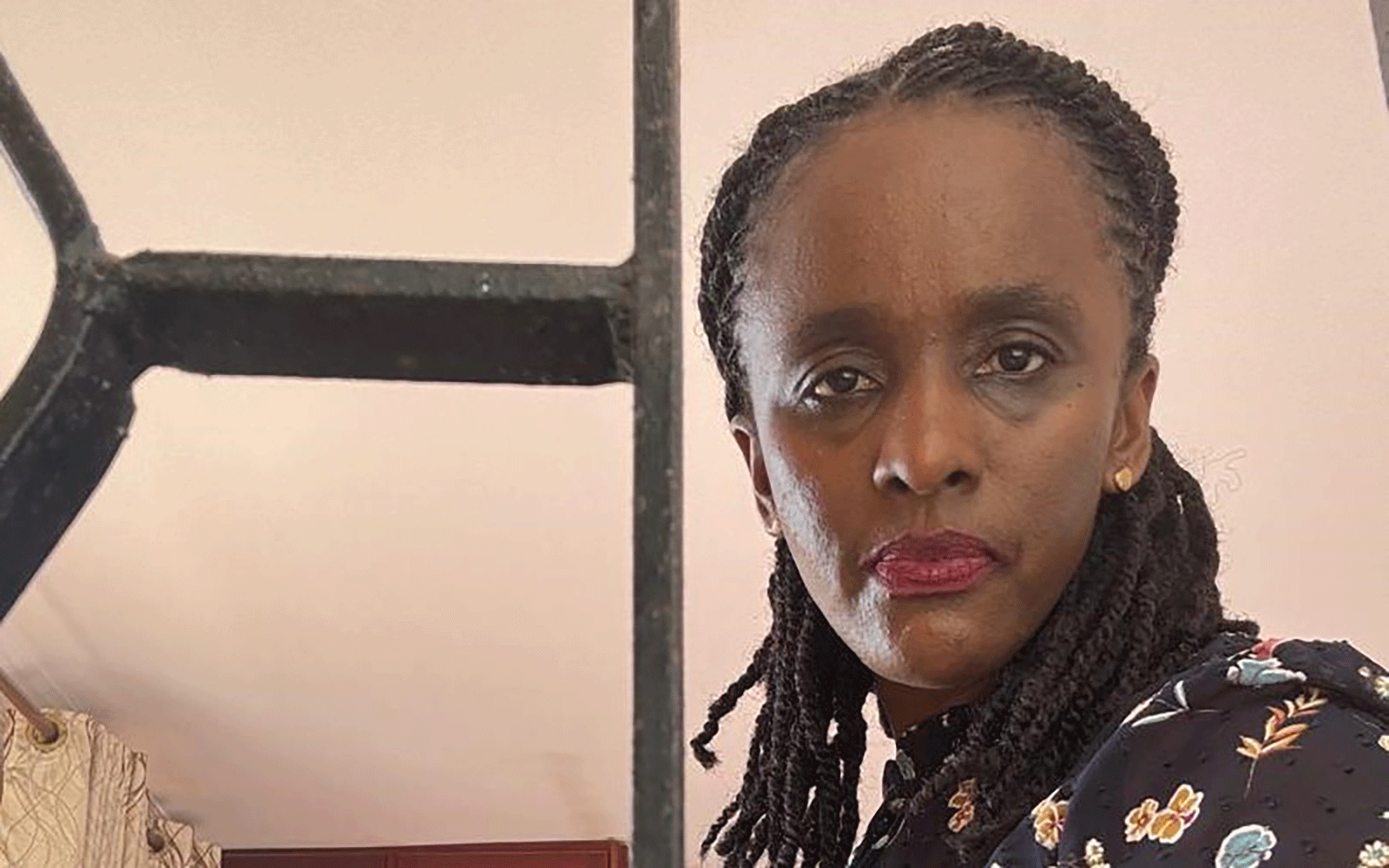
To coincide with our Africa special issue of September 2025, we interview Tanzania-based Susan Rumisha about her work on malaria in sub-Saharan Africa, and her life beyond the laptop.
You’ve studied or worked in several European countries, as well as in Australia. Why is Tanzania the place for you right now?
Tanzania is where my journey began, it’s where my roots are. While the scope of my work spans continents, delivering what I need to do from Tanzania gives me a profound sense of belonging. So, I was so honoured when the base of my current job happened to be in Tanzania. Staying here also provides the privilege of translating global insights into locally relevant solutions, including strengthening health systems from within and empowering the next generation of home-grown experts.
As principal research scientist at the Ifakara Health Institute in Dar es Salaam, what are you focussed on right now?
My top priority is supporting our dedicated team to deliver high-quality and informative malaria risk maps for a couple of malaria endemic countries in sub-Saharan African. These risk maps are the backbone to guide countries through critical decisions including informing their next 4-5 year strategic plans, justifying tailored intervention mixes, and backing financial investment requests. It’s high-stakes work that is done by quite a young and small team, who still require some coaching.
What project have you felt most personally attached to?
That would be back in 2014, when I led a team tasked to conduct the national quantification of medicines and medical supplies for Tanzania. Oh wow, what a ride that was! The task was hard and demanding. There was no reliable data to apply usual quantification methods to, so that flew out the window. I had to learn new things on the fly, be creative and really think outside the box and we finally delivered great work. But, surprisingly, I loved every bit of it. It pushed me, shaped me, and looking back, I’d happily do it all over again.
The idea of returning home, i.e. to Tanzania, and being in the continent to lead that bold vision of strengthening analytical and modelling skills across Africa, honestly gave me goosebumps
What statistical techniques do you use most in your everyday tasks?
Honestly, I can’t say there’s just one. My work is a journey; it feels more like being in a kitchen preparing a meal. You start with data wrangling (which is an art in itself!), moving through descriptive, correlation, sometimes regression analyses and then turning up the heat by diving into advanced modelling and making predictions about various health metrics. So, rather than sticking to one technique, I use a mix of whatever gets the job done and tells the story the data holds in a meaningful way.
What have been the proudest moments in your career so far?
One of my proudest moments was when my team secured funding to establish the Africa-based node of the Malaria Atlas Project (MAP). The idea of returning home, i.e. to Tanzania, and being in the continent to lead that bold vision of strengthening analytical and modelling skills across Africa, honestly gave me goosebumps. I had dreamt of this since I was about 25. Seeing it come to life, and being personally at the forefront of something so purpose-driven, has been incredibly fulfilling.
What do you consider the biggest barriers to modernising data gathering and analysis in Tanzania – and across the continent of Africa?
There are several, and they span a spectrum, i.e. from technical barriers (which are somehow easier to fix) to systemic barriers (which are more complex). Technical difficulty includes how data is collected – it often happens in fragmented silos, with little integration across systems, sectors or institutions on what should be collected, or its pathway, resulting in unnecessary data, systems, duplication, and no sharing for use. A vivid example in the health sector is that the DHIS2 [an open-source software platform formerly known as District Health Information Software], which is for routine health data, and logistics management information systems (LMISs) for logistics and supply chain data, do not talk to each other. In the middle, you have the infrastructure, which is massive in rural areas where most of the data originates. Lack of reliable connectivity, power, modernised hardware, etc. makes it so hard to transmit good data in a timely, modern way. The most difficult barrier, which also has little investment, is human capacity. There is a generational gap when it comes to having the right people for the job. Period. While a lot is happening in building skills, including the project I lead, most initiatives lack sustainability, which is another barrier.
In many African countries, data can often be incomplete, patchy or biased
Does AI present any particular opportunities and risks for your work in tackling malaria?
Absolutely! The opportunities are plenty. AI can process vast and complex datasets so quickly, identify patterns and insights that humans might miss. If trained well it could even generate predictive insights like risk maps to guide new initiatives or how to optimise resource allocation in a timely manner. But as the appetite to adopt AI algorithms grows, the bigger the risks, especially given the nature of the existing data. AI is only as good as the data it is trained on, and in many African countries, data can often be incomplete, patchy or biased, hence require careful navigation. Some initiatives are done as pilot projects, or in small areas, hence no ability to produce generalisable outputs, as in Zanzibar, Mozambique, Ghana, Tanzania, etc. There is a tendency to adopt exciting algorithms that have performed elsewhere, which is tempting if we need to catch up with the changing times, but we may fall into “black box” solutions that are too difficult to sustain. My personal view is that AI should be seen as a powerful assistant, but should always be complemented by contextual knowledge, experience and expertise.
What advice would you give your 21-year-old self?
Put no limits on what you can dream, learn, and master. The brain is an incredible organ; you’ll be amazed by what it can absorb. Don’t be afraid of failing or making new mistakes, they’re part of the journey. Keep going, but take a moment to look back to be sure you are moving forward, and value every second of your time.
What do you enjoy doing when you’re not working?
The first thing that comes to mind is “Let me catch up on some sleep.” But the moment I lie down, be it on the bed or sofa, I will remember something that I needs cleaning. I am a bit of a cleanaholic. Off I go and – ta-dah! – I am trapped. I actually enjoy that sparkle-level kind of cleaning — it’s oddly therapeutic.
If you had to choose a different profession, what would it be?
Oh, this I know. I’d be a musician!
Read our Africa special issue now.
You might also like: 5 minutes with: Immaculate Kathomi Murithi